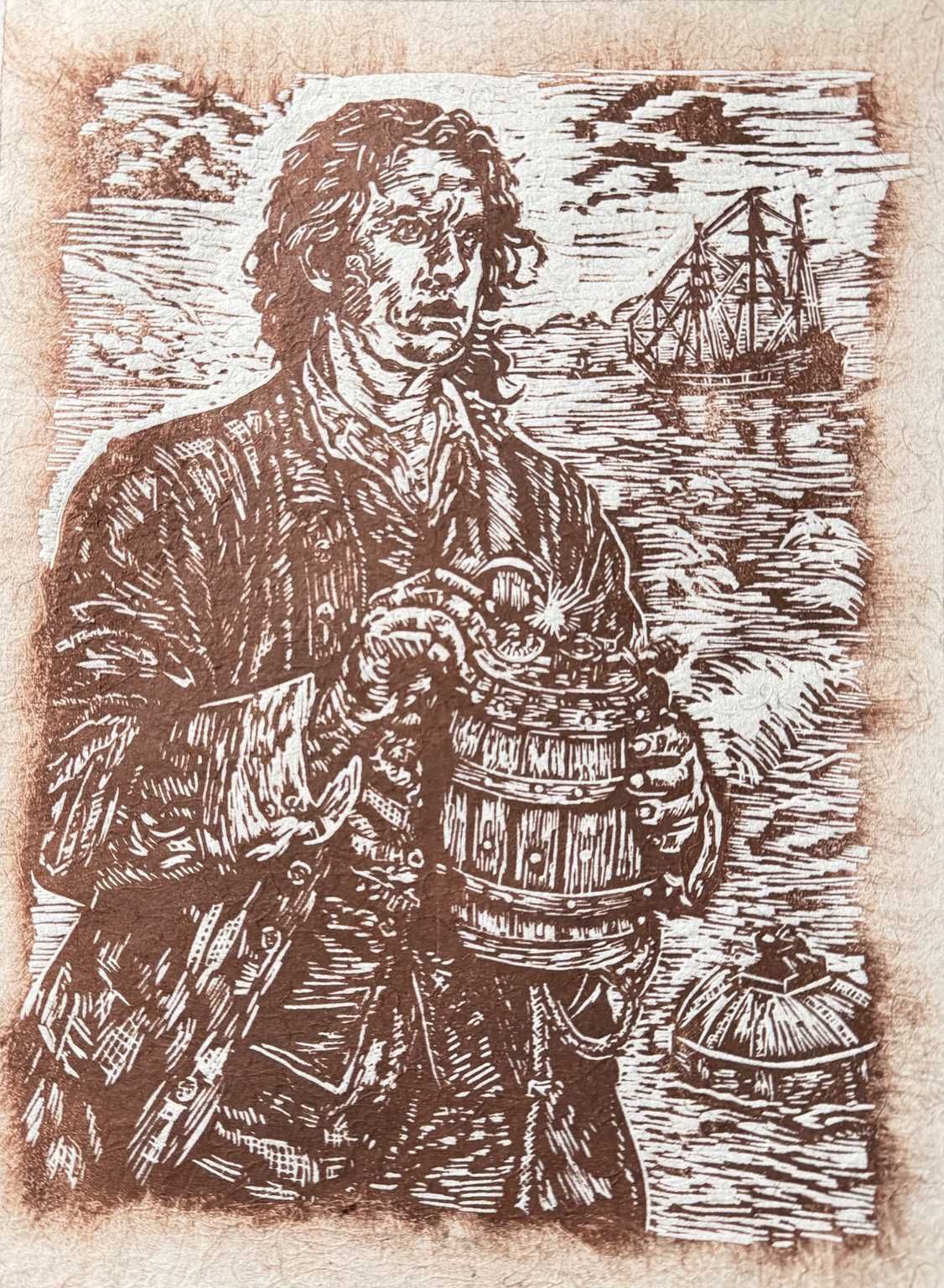
David Bushnell and the Battle of the Kegs
When most people think of the American Revolution, they picture soldiers crossing icy rivers or standing in long battle lines. Few remember the quiet inventor whose imagination carried the war beneath the water.
David Bushnell (1740–1824), a Yale graduate and patriot, believed that Britain's greatest advantage—its powerful navy—could be challenged with invention rather than numbers. His experimental submarine, the Turtle, became the world's first combat submersible, introducing concepts that would influence underwater warfare for generations. Although its 1776 attack on the British warship HMS Eagle was unsuccessful, Bushnell refused to abandon his ideas.
The following year, his attention turned to a different weapon: floating explosive mines. These wooden powder kegs, fitted with ingenious clockwork and contact mechanisms, were designed to drift silently with the current until they struck an enemy vessel.
That innovation connects David Bushnell directly to Bordentown, New Jersey.
The powder kegs used in the famous Battle of the Kegs were constructed in the cooperage of Colonel Joseph Borden in Bordentown before being transported to the Delaware River. In December 1777 and January 1778, hundreds of Bushnell's floating mines were released upstream in an attempt to destroy the British fleet anchored off occupied Philadelphia. Although they caused little physical damage, they achieved something equally important—they spread fear and uncertainty throughout the British fleet. Sailors fired muskets and cannon at every floating barrel, log, and piece of debris they encountered, creating a spectacle that became immortalized as the Battle of the Kegs. Francis Hopkinson later celebrated the event in his famous satirical ballad, turning Bushnell's inventive attack into one of the Revolution's most memorable stories.
Bushnell continued serving the Continental Army as commander of its Corps of Sappers and Miners before quietly disappearing from public life after the war. He eventually settled in Warrenton, Georgia, where he lived under the name David Bush, practicing medicine and teaching school until his death in 1824. He is buried in Warrenton City Cemetery, far from the waters where his remarkable inventions first challenged the world's greatest navy.
Today, David Bushnell is remembered not only as the inventor of the Turtle, but as the father of underwater warfare. His ideas transformed naval combat, proving that innovation could be as powerful as armies—and that even a humble wooden powder keg launched from the banks of the Delaware could become part of American history.