Harry Mayer
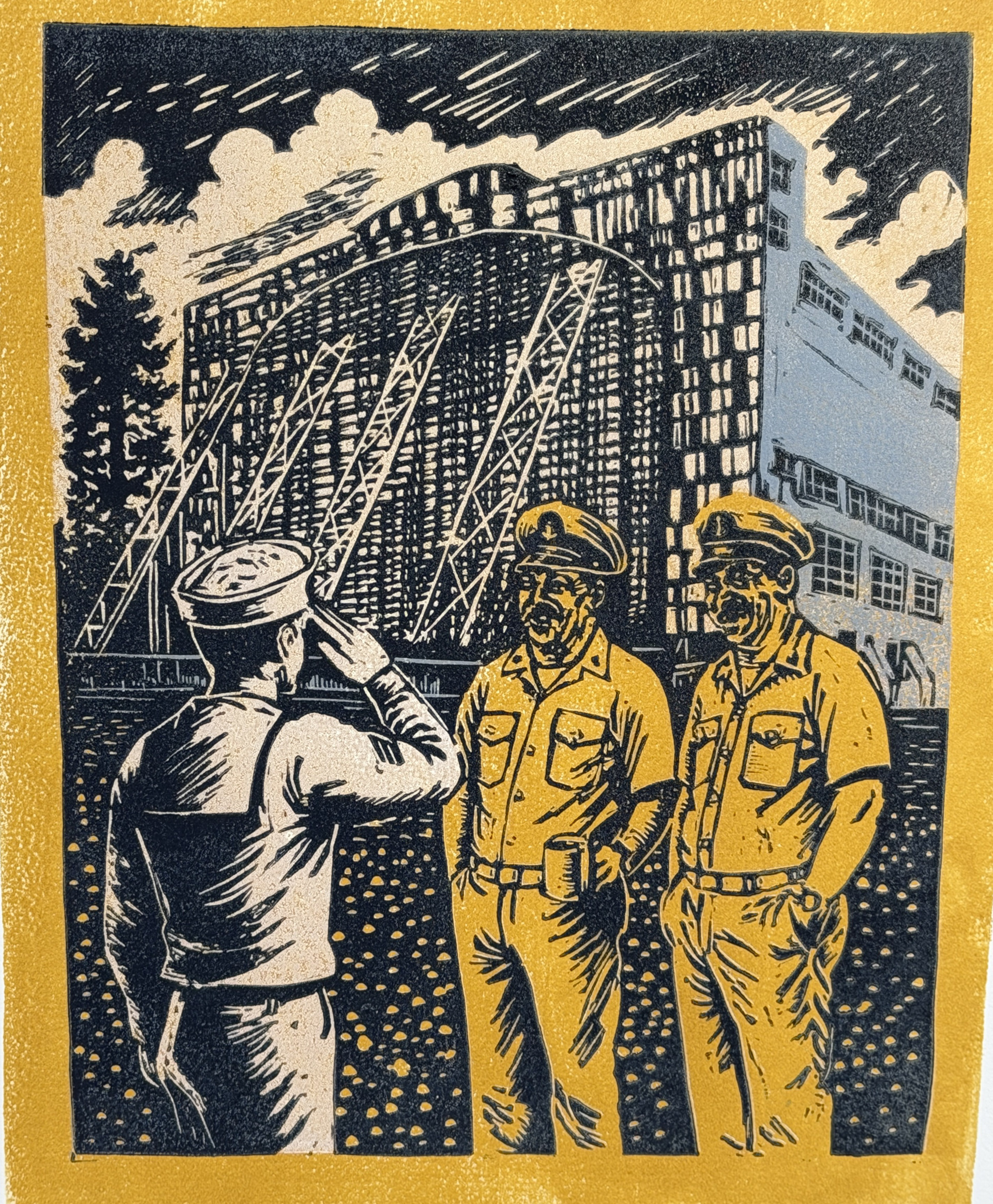
Helicopter Anti-Submarine Squadron Seven Five
Lakehurst Naval Air Station, New Jersey
Autumn 1979
Hangar One loomed large beyond a forest of pitch pines. The colossal blimp hangar, old and weathered now, cast a long shadow across my Volkswagen Beetle. Beyond it stood Hangars Five and Six, the largest freestanding wooden structures in the world. They looked like Quonset huts built for giants.
The Navy built the enormous hangars to house the zeppelins that once patrolled the East Coast searching for enemy submarines.
Lakehurst felt familiar, almost like a homecoming. I went to high school with kids from town, and my family had deep ties to the naval air station. Aunt Pearl worked the telephone switchboard during the Hindenburg disaster in 1937. Her eyes would light up whenever she described plugging wires into the switchboard as news of the catastrophe spread around the world.
After World War II, my grandfather worked on base as a maintenance man, and Aunt Jerry became the “timekeeper” on the famous jet sled project. As a kid I thought that sounded exciting. I imagined her wearing goggles and earmuffs, timing rocket sleds with a stopwatch. Years later I learned “timekeeper” actually meant payroll clerk.
Reality can be disappointing.
I pulled into the gravel parking lot beside Hangar Six for my first drill weekend as an Emerald Knight. The stones crunched beneath the tires as my Love Bug rolled to a stop.
I still wasn’t sure transferring into the Navy Reserve had been the right decision.
There were no Marine reserve units close to home, so my options were limited. Either join the Navy or risk being recalled to active duty and put college on hold for another four years.
Don’t get me wrong — I loved being a Marine.
Whenever I saw the Eagle, Globe, and Anchor my chest swelled with pride. If someone played the Marine Corps Hymn, I jumped to my feet so everyone would know I was one of the Few and the Proud.
I didn’t particularly like sailors, and I made little effort to hide it.
They were soft. Undisciplined. They couldn’t shoot straight, hell, they couldn’t even march.
And now I was one of them.
Everything happened fast. Four weeks earlier I sat in a reserve recruiter’s office while he reviewed my ASVAB scores. He told me there was an opening in a helicopter squadron for an “AWAN.”
I had no idea what he was talking about.
He explained that AW stood for Aviation Warfare Systems Operator and AN meant Airman. He also informed me I’d be an “AW striker” until I qualified.
“Striker?” I asked.
In high school I played soccer, so I knew what a striker was, but I had no idea what it meant in the Navy.
Eventually I figured out that “rating” was Navy language for MOS and “Airman” was just their version of Lance Corporal.
The recruiter asked if I wanted to become a helicopter aircrewman.
I said yes immediately.
Flying around in helicopters hunting submarines sounded a hell of a lot better than humping a PRC-77 radio through the woods behind a lost second lieutenant.
The Operations Officer explained the Emerald Knights flew SH-3 Sea King helicopters searching for Soviet submarines. My job would be learning sonar systems used to locate enemy boats so the pilots could attack them with torpedoes.
By the end of the day I was discharged from the Marine Corps, sworn into the Navy, and handed a chit for my initial seabag issue.
This Navy thing was going to be easy.
The Marine Corps taught me many things: discipline, military bearing, and attention to detail.
I intended to show up looking squared away.
I spent hours spit-shining my dress shoes until they gleamed like black mirrors. Then I polished my brass belt buckle until it sparkled like gold. Using a ruler, I carefully measured and sewed my airman stripes onto both sleeves of my white uniform shirt.
To top things off, I got a fresh high-and-tight haircut.
Now I was ready to rock and roll.
I placed my Dixie Cup cover carefully on my head, checked the brim position with two fingers against the bridge of my nose, and marched toward the green-painted side door of Hangar Six.
Just before I reached it, the door swung open and a pudgy sailor in double-knit khakis stepped outside.
He had a scruffy gray beard, hair hanging over his ears, and a belly hanging over his belt. In one hand he clutched a coffee mug like it contained life itself.
I didn’t recognize the insignia on his collar, but I remembered one universal military rule:
When in doubt, salute.
I snapped my hand sharply to my brow.
“Good morning, sir.”
The sailor froze and stared at me.
“What the fuck did you just call me?”
Caught completely off guard, I stammered.
“Good morning… sir?”
“That’s what I thought you said.” He stepped closer. “Don’t ever call me sir again.”
“Call you what, sir?”
“Sir, you idiot. I’m a Chief Petty Officer. You only call officers sir.”
Another chief stepped outside and immediately stopped.
“Jesus Christ,” he muttered. “Look at this guy.”
The two chiefs circled me like sharks.
“Kid,” the second chief said, “did you ever go to boot camp?”
“Yes, Chief. Parris Island.”
“Ohhh,” the first chief laughed. “A jarhead. That explains everything.”
The second chief pointed at my belt.
“Is that a gold buckle? Jesus, kid, only officers and chiefs wear gold buckles.”
Then he noticed my sleeves.
“And look at this. He put stripes on both arms.”
The chiefs burst out laughing.
“Son,” one of them said, “you’re more fucked up than Hogan’s goat.”
I stood there mortified while they laughed at me.
Finally, one of the chiefs shook his head.
“You can’t drill looking like that. The old man would lose his mind.”
He disappeared back inside the hangar and returned a few minutes later carrying photocopied pages from the Navy Uniform Regulations manual.
“Go home,” he said. “Square yourself away and come back tomorrow. I’m giving you an unsat for today’s drill, but if you can un-fuck that uniform, I’ll schedule a makeup drill later in the week.”
“Yes, S—”
I caught myself.
“Yes, Chief.”
He smirked.
“Kid, you’ve got a lot to learn about the Navy.”
With the wind completely knocked out of my sails, I climbed back into my Beetle and headed home.
The Marine Corps taught me discipline, determination, and perseverance.
Unfortunately, it took a couple of Navy chiefs to teach me humility.
Autobiographical Fiction Disclaimer
The Hogan’s Goat is a work of autobiographical fiction inspired by the author’s experiences in the United States Marine Corps and Navy Reserve during the Cold War era. Certain names, dialogue, characters, and events have been altered or condensed for literary purposes.