Set on the bomb-scarred Hawaiian island of Kahoʻolawe, this story follows a young Navy EOD officer during his first real-world unexploded ordnance disposal operation. Part psychological portrait and part meditation on fear, adrenaline, and mortality, Kahoʻolawe explores the strange tension between terror and exhilaration that exists at the edge of danger.
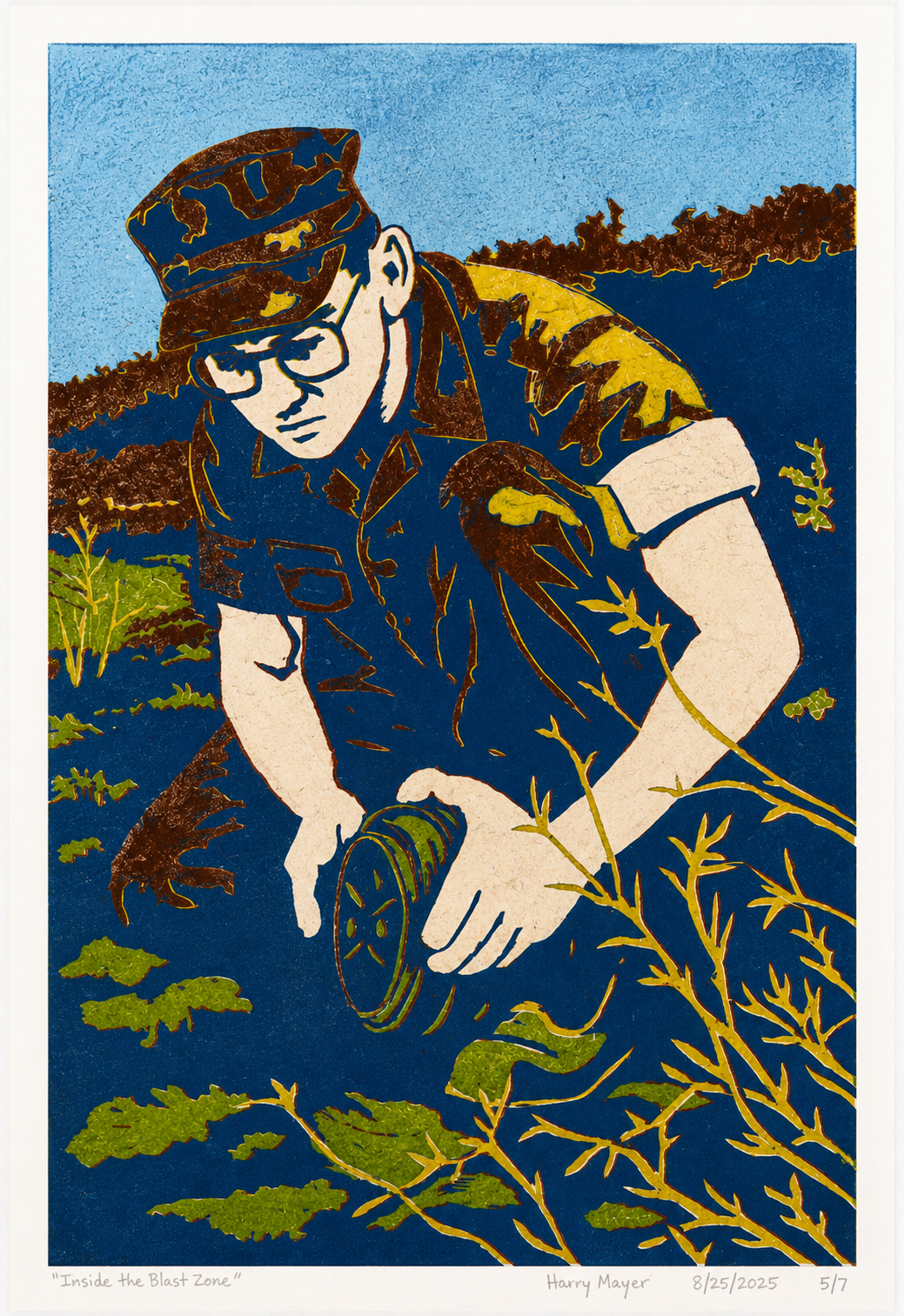
Kahoʻolawe
Harry Mayer
The beast is sleeping, buried deep beneath the red dirt. He sleeps under the adze quarry, where ancient Hawaiians once mined volcanic glass for weapons. He is dormant now, waiting for someone to wake him from his slumber. If disturbed, he will release his explosive energy with violent rage, destroying and killing with hateful vengeance. His skin is thick and olive drab. My enemy is not human, but it was made by men for one purpose — indiscriminate killing. The beast, my enemy, is a 250-pound unexploded bomb, waiting to be discovered… waiting for me.
The sky is nearly black from heavy cloud cover. It has been raining constantly for two days. It’s unseasonably cold, and my clothes are soaked. The heavy rains and high winds have grounded our search and rescue helicopter. Range clearance operations have ceased until the weather breaks.
I’m anxious. I’m a newly qualified Navy EOD officer conducting my first real-world explosive ordnance disposal operation. The Senior and Master EOD techs refer to my team as a gang of “Slick Bombs,” implying that we are unproven Basic EOD techs with only schoolhouse knowledge.
We are on the island of Kahoʻolawe, a small uninhabited island six miles southwest of Maui. No one lives here except for feral goats and birds. This is a barren place, not like the other islands in the Hawaiian chain. Kahoʻolawe is rocky, sunbaked, and littered with unexploded bombs, missiles, rockets, and projectiles. Following the attack on Pearl Harbor, the Navy turned the island into a bombing range. Thirty-five years of unexploded ordnance lie beneath the red earth, their explosive fillers becoming more sensitive with time.
Our base camp at Kanapou Bay is Spartan. We have no showers because there is no freshwater source on the island, so we bathe in saltwater at the beach. Our generator is broken, and there is no chance of getting repair parts until flight operations resume.
Thick red mud flows down from the hills. The mud clings to everything. I put off going to the field latrine until I can’t wait any longer. Then I make the long trek through the torrential rain to the pit toilet. Rather than spending the rest of the day scraping caked mud from my jungle boots, I decide to go barefoot. I look like a Hobbit when I return, my oversized feet encased in thick red mud.
At the rear of the hooch, the Range Chief, Chief Petty Officer Jones, is standing in the rain completely naked except for his jungle boots and camouflage flop hat. A lit cigarette hangs from his upper lip beneath a thin black mustache. His skin is tough, tanned, and wrinkled, with large ship propellers tattooed on his butt cheeks — one labeled port, the other starboard. Years of heavy drinking, smoking, and combat duty in Vietnam have taken their toll. He rarely speaks. Most of the time he just stares and smokes.
Ensign Mike Spott is the officer in charge of the Kahoʻolawe Detachment. Mike is only an Ensign, but he is also a Limited Duty Officer, which means he spent years as an enlisted Master EOD Technician before being commissioned.
Mike turns to me and says, “Tomorrow, if this damn rain ever lets up, we’re gonna start sweeping around Puʻu Moaʻula Iki. The archaeologists were up there a couple weeks ago and found ancient relics. This rain is gonna uncover a bunch of UXOs, so I think we’re gonna be busy.”
“UXO, what’s that?”
“Christ, you really are a slick bomb. UXO means unexploded ordnance. Don’t worry, this island is the best damn training ground in the world for new techs.”
Mike’s face bears a horrific Y-shaped scar that runs from his forehead, over the bridge of his nose, and splits across the rest of his face. Last year, while excavating an unexploded 2.75-inch rocket, he triggered its flare assembly and caught it directly between the eyes, opening his face like an oyster and collapsing his sinus cavities. Miraculously, he returned to full duty.
That night I lie awake in darkness listening to the rain hammer against the steel hooch. I am filled with anxiety, fear, and trepidation, but also excitement. This is the job I volunteered for. What will I do when I confront my first UXO? Can I overcome fear and prove worthy of wearing the EOD Crab?
By morning the rain has stopped.
The surf has returned to a slow, peaceful cadence as it laps against the shore. Chief Jones shouts:
“OK assholes, pack your shit and be ready to board the Gama Goats at 0700...”
The ride to the operating area is brutal. The Gama Goat tears through mud gullies while the island stretches around us like a war-scarred wasteland. The vegetation has long since been stripped bare by feral goats. If not for a few thorny Kiawe trees, the island could pass for Mars.
The day becomes a series of blow-and-go operations. We locate UXOs and destroy them in place. My jungle boots rub blisters into my feet, and my face burns beneath the Hawaiian sun.
Late in the afternoon Mike signals me over.
“Hey Harry, what do you make of this?”
The rain has carved a deep gully through the archaeological site. Embedded in the mud is something resembling the bark of a tree. But there are no trees here.
“Harry, go down there and check it out.”
I carefully descend into the ravine, touching the ground first to discharge static electricity before handling the object. I pour water from my canteen over the strange branch-like shape, washing away the mud.
It isn’t wood.
It has rough olive-drab alligator skin.
A bomb.
Slowly I uncover more of the object. The deeper I dig, the larger it becomes. Cylindrical. Tapered. Then I see the yellow band — the color code for high explosives.
A 250-pound general-purpose bomb.
I expose the nose.
The fuze is armed.
This bomb has been buried for decades, waiting.
I retreat and report back to Mike.
“Looks live. We should blow it in place.”
“I wish we could,” Mike says. “But we’re right in the middle of the archaeological dig. A high-order detonation will destroy everything up here. We only have one option. We’re gonna render it safe.”
Back at camp that night, Chief Jones, Mike, and I sit outside the hooch.
“What’s your plan tomorrow?” Mike asks.
“The primary RSP requires specialized tools we don’t have,” I say. “The alternate procedure calls for hand removal.”
Chief Jones inhales deeply on his cigarette.
“You volunteered for this, Lieutenant. If you’re gonna draw gunfighter’s pay, once in a while you gotta get in a gunfight. Just don’t turn yourself into a pink mist.”
That night I barely sleep.
Many EOD technicians go their entire careers without removing a live fuze from a bomb by hand. Yet I am about to perform one on my very first render-safe procedure.
The next morning I kneel beside the bomb.
Of all the tools available in the EOD arsenal, the most important one today is a simple pipe wrench.
My heart pounds, but my breathing remains slow and deliberate.
Cowardice would be worse than death.
I place the jaws of the wrench carefully onto the fuze.
I pull.
Nothing.
I pull again.
Still nothing.
Then I lean harder against the wrench until suddenly the fuze breaks free.
Loose.
I remove the wrench and slowly unscrew the fuze and booster from the bomb.
The brains and heart of the beast are finally gone.
The fuze lies in the red mud beside me, small enough to fit in one hand, yet moments earlier powerful enough to erase me from existence.
I should have been terrified.
Instead, I feel euphoric.
The adrenaline rush is overwhelming. I want to feel it again.
That realization frightens me more than the bomb ever did.
I understand now that this craving cannot be explained rationally. None of this makes sense. Yet this is the most alive I have ever felt.
I must accept the fact that disarming bombs is irrational.
And I must also accept another truth:
I am no longer a rational person.
Disclaimer:
This story is autobiographical fiction inspired by real events and experiences. Certain names, characters, dialogue, timelines, and operational details have been changed, condensed, or fictionalized for narrative purposes.
This story is autobiographical fiction inspired by real events and experiences. Certain names, characters, dialogue, timelines, and operational details have been changed, condensed, or fictionalized for narrative purposes.