Set against the backdrop of Naval Air Station Lakehurst in 1979, I Hate Professor Dobbs is a coming-of-age story about youth, military service, ambition, and the quiet ways tragedy reshapes our understanding of other people. Through the eyes of a young, enlisted aircrew candidate, the story traces the collision between youthful arrogance and the deeper realities of sacrifice, grief, and human vulnerability.
Blending memories of Naval Aviation with reflections on time and mortality, the story captures a moment when ordinary lives are forever altered by events beyond anyone’s control.
I Hate Professor Dobbs
Harry Mayer
Naval Air Station Lakehurst
New Jersey, 1979
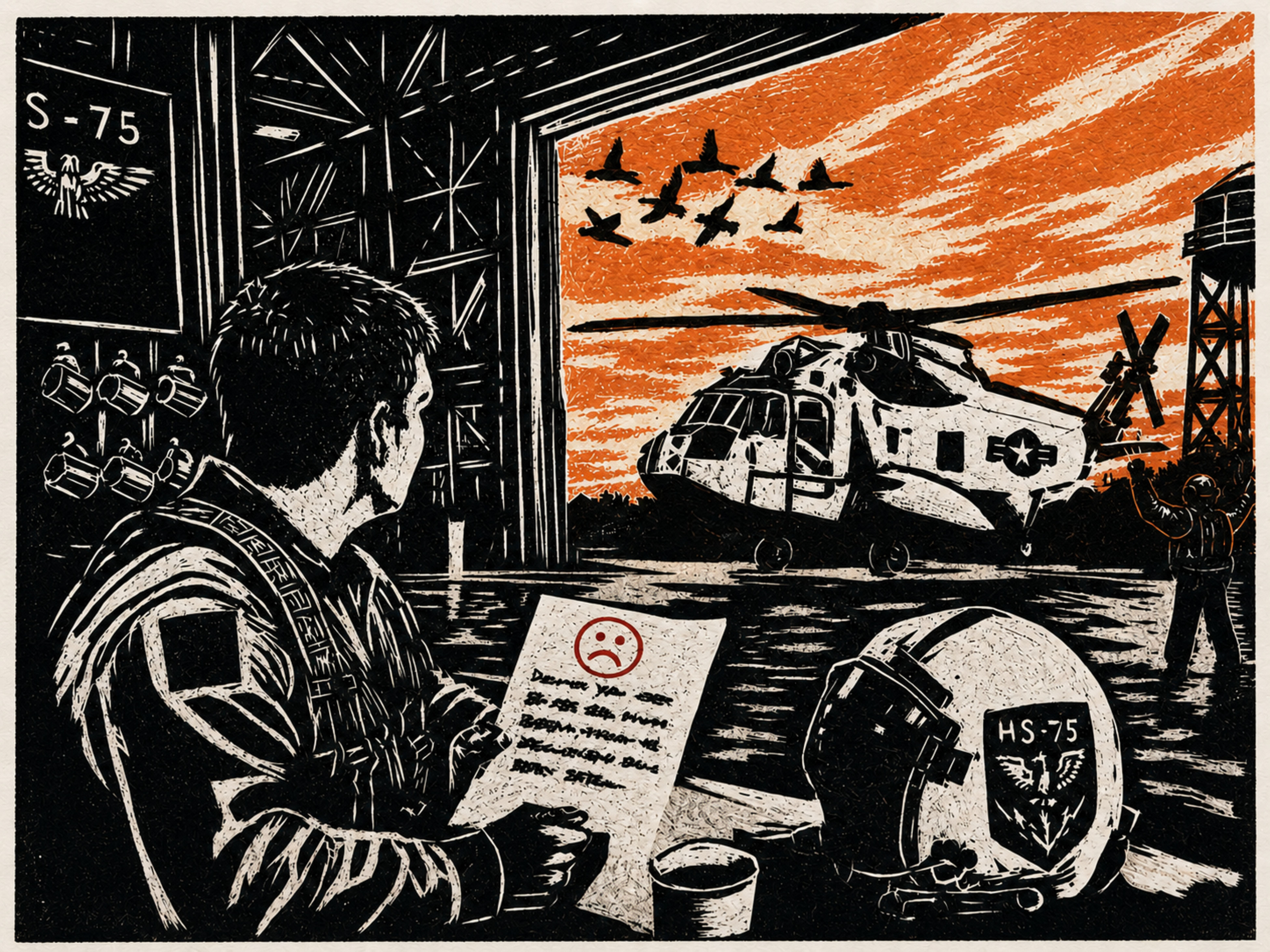
Despite bright mercury lights, it seemed dark in the old blimp hangar. Flapping pigeon wings echoed in the large empty space. When I looked up, several birds were joining the flock that had made their home on the rickety catwalk. The wooden catwalk was a death trap, 120 feet above the floor, with missing boards and a broken handrail. But this didn’t bother the pigeons, they happily built their nests near the massive hangar doors. Just below the catwalk white bird droppings splattered the old walls too high above the floor for maintenance workers to clean. This gigantic building once housed the Navy’s Zeppelins that patrolled the East Coast hunting submarines. It felt like I had stepped into an old black and white war movie, and I half expected to see Gregory Peck in a leather flight jacket briefing the pilots in the Ready Room.
Dressed in a green flight suit, I entered the Ready Room and hung my aircrew survival vest over the back of a chair. A row of squadron cups hung on a pegboard near the coffee mess. I didn’t rate a squadron cup yet because I was only an aircrew candidate. Once I earned my wings, I could hang my cup on the wall with the others. I poured a cup of stale black coffee into a Styrofoam cup and took a seat to wait for the Pre-Mission Brief to begin. I arrived an hour early since this was my first flight as an enlisted aircrew candidate, and I was filled with apprehension. With only two drill weekends under my belt, I still had a lot to learn. One of the things I liked about the Naval Reserve was that I could earn extra money during the week to work on my qualifications, the perfect part-time job for a college student.
With time to kill before the briefing I pulled out a sealed envelope from my helmet bag. I had been struggling in Professor Dobbs English Literature Class. I didn’t particularly care for Professor Dobbs. She struck me as a pedantic woman overly obsessed with social justice. With her blond hair tied in a tight bun and wearing a frumpy sweater her eyes would light up when she talked about the anti-war movement of the 1960’s. She could turn any discussion into an obscure lecture on the evils of the American defense industrial complex.
While I usually read her assignments, I rarely participated in class discussions. I found the course material boring. Our most recent assignment had been a 5-page essay on The Role of Madness in Hamlet: Insanity or Strategic Ploy. I read every analysis of the Danish prince I could get my hands on. I was sure I nailed the assignment this time.
I took a deep breath and tore open the envelope to review my grade. In bright red ink across the top of the page was the letter “D” with a frowning smiley face. Then I read the comments, “Mr. Mayer, while this is certainly a well written paper, I have a sneaking suspicion that someone else wrote it.” My face turned redder than the ink on the page. I muttered, “That Bitch!” Petty Officer Perdue, who was sitting in the row of seats ahead of me, turned and said, “Did you say something?” I sighed, “It’s nothing.” I stuffed the paper back in the envelope.
Petty Officer Perdue, a first-class petty officer with over 1,000 hours in Sea King helicopters was my NATOPS instructor. After the mission brief, I followed Perdue to the flight line. A blast of hot jet exhaust from returning Helicopter 552 hit us in the face. The smell of burning JP-4 hung heavy in the air. Helicopter 552 engines screamed on deck while its large rotor blades beat the air. A plane captain, wearing a cranial head protector and goggles signaled the returning flight crew to shut down as we headed to our aircraft. We conducted a walk around pre-flight inspection of our bird. I read the checklist and Perdue showed me what to inspect. Once onboard I took the right seat near the window, Purdue took the inside one. He showed me how to plug into the Internal Communication System, once I did, I could hear the pilots talking in my helmet. Perdue said, “Tonight’s going to be simple. We’re doing some touch and goes, and if we have time, we’ll do some practice with the hoist. Are you up for riding the wire?” I nodded.
I listened to the pilots recite the actions from the take off checklist. Then a voice from the tower said, “5-5-5 your clear for takeoff.” The helicopter aircraft commander brought the engines up to speed and pulled back on the collective. We took off at twilight. I watched out the window as we rose into the early evening sky. The red and white checkered water tower and the enormous Lakehurst hangars grew small as we climbed above the Naval Air Station. I marveled at the Pine Barrens at dusk, the sky’s red, blue, and orange hues slowly fading into darkness. Soon the red lights came on inside the cabin as we flew into the night.
Perdue called to the pilots, “Pilot-Sonar. Request permission to unstrap to conduct post takeoff inspection.”
“Permission granted.”
Perdue unstrapped from the seat and meticulously inspected the interior of the aircraft. He inspected the control cables, hydraulic lines, and the integrity of the air frame. Then he strapped back in his seat. “Pilot-Sonar. Post takeoff check complete.” For the next three hours the pilots practiced their take offs and landings. Then a voice came over the ICS, “Sonar-Pilot. You guys want to get some practice with the rescue hoist?”
“Sonar-Aye.”
Perdue signaled me to follow him to the back of the helicopter. He handed me a gunner’s belt and showed me where to fasten it to the air frame. Once we were properly hooked up, he slid open a large door at the back of the helicopter. After we were in a stable hover, he hooked me up to the hoist and then pushed me out of the door. I dangled out of the helicopter suspended on a tiny wire while he lowered me to the pad. Once I hit the ground I unhooked and waited for the chopper to return. As our flight was coming to an end, we practiced auto rotations, an emergency procedure for engine loss. Once at altitude the pilots disengaged the rotor head, and we dropped from the sky. It felt like the first drop on a giant roller coaster at Great Adventure. Although this was my first flight, I was hooked. I knew I was going to love this job and couldn’t wait to come back.
I returned to college eagerly looking forward to the next drill weekend. I had a paper due on Friday on The Tale of Two Cities. I sat at the desk in my room and stared at the Underwood typewriter. I searched for words to fill the blank page, while Bruce Springsteen’s Thunder Road played on the radio. Just as I started to clack and clunk on the manual typewriter, my train of thought was interrupted by the WJRZ news announcer. “Good afternoon, ladies, and gentlemen, this is George Jessup, we’re breaking into our regular programming with this developing story. A naval reserve helicopter from Lakehurst Naval Air Station, on a routine training flight crashed in a farmer’s field near Bordentown, NJ. Navy officials reported earlier today there were no survivors. While the cause of the crash is unknown, the Navy promises a thorough investigation. Our thoughts are with the families of the flight crew. Stay with us for continuing coverage of this story, we now return to our regularly scheduled programming.” Even though I hadn’t been in the squadron long enough to know the members of the flight crew, I had a sinking feeling in the pit of my stomach. I lost all interest in the essay. Up to this point danger seemed abstract, like it would happen to someone else. For the first time I realized, I could get killed in the reserves, even in peacetime.
The next day, I waited with the rest of my class for Professor Dobbs. Our English Literature Class was supposed to begin at 10 AM but she still had not arrived. By 10:15 students started to leave. A long-haired kid in an Army fatigue jacket said, “Man, I lucked out, I’m glad she didn’t show up today. I was partying last night, and I never completed the paper. What about you?” I said, “Hell yeah, I was working on it until midnight.” The next day I received a call from the HS-75 Duty Officer who told me there would be a memorial service at the Cathedral of the Air in Lakehurst on Saturday morning.”
Just beyond Red’s Tailor shop on South Chapel Road stood the Cathedral of the Air. A beautiful Norman-Gothic chapel nestled among the pines. Sailors gathered in dress uniforms outside the church. A blanket of auburn pine needles covered the ground. A cold November breeze blew brown oak leaves across the parking lot. We waited in respectful silence for the memorial service to begin. Black limousines carrying grief-stricken family members started to arrive. I was surprised when I saw Professor Dobbs get out of the second limo with her teenage son. She was dressed in a black dress with a black veil. She took her seat in widows’ row at the front of the chapel. Soft, colorful light filtered into the sanctuary through the chapel’s magnificent stain glass windows. The atmosphere was melancholy, yet peaceful as the organist played, “Nearer my God to Thee”. I took a seat in the pew near the back.
Captain Reynolds, the Commanding Officer walked to the podium. He said, “Ladies and gentlemen, officers, and men of Helicopter Anti-Submarine Squadron Seven Five. We are here to celebrate the lives of Commander Douglas Dobbs, Lieutenant Commander George Chadwick, and Petty Officer First Class Amelio Santangelo. Over the course of my career, I have attended too many memorial services. These brave young men, struck down in their prime only wanted to serve their country. They were America’s best, and I felt proud to personally know all three. These were men of character, who cheerfully answered their country’s call to duty when asked and served with honor in Southeast Asia. We mourn their loss with great sadness and pray we are worthy of their sacrifice.”
Following the Skipper’s remarks, he invited family members, colleagues, and friends to speak. Professor Dobbs walked to the front of the chapel. Despite her bravest attempt to look stoic, she appeared fragile. She wiped away tears with a handkerchief. There was a long pause. She started to cry when she began. She said, “I’m sorry.” She paused again. Then she spoke, “Today, we are here to celebrate the lives of three wonderful men, George, Amelio, and of course my Doug.” Her voice quivered.
She continued, “Doug was not only the great love of my life, but he was also my best friend. Memories. So many memories. I remember when I was in graduate school, and he was a midshipman at the Naval Academy. He looked so handsome in his uniform. We would sit for hours on Sunday morning at Naval Bagels on Taylor Ave. He always knew the right thing to say, it was such a happy time. He would make me laugh when he spoke of some of the mischief he got into at the Academy. More than anything, he wanted to fly. His eyes would light up when he talked about flight school. He couldn’t wait to earn his pilot wings.
“When my oldest brother John was drafted, and later killed in Viet Nam, he comforted me. Doug was always there when I needed him. When I gave birth to Jason, he sat by my side in the delivery room for a day and a half holding my hand. He was my rock. I felt safe in his arms.
“My heart sank the day he broke the news to me that HC-1 was deploying to Viet Nam. He told me not to worry, he would be safe on the RANGER. I was scared for him. Dougie had the heart of a poet and wrote me some of the most beautiful letters, I’ll treasure those letters forever.
“When he returned from deployment he had changed. He had soured on the Navy and just wanted out. Once his initial service obligation was up, he submitted his Intent to Resign. I was ecstatic when he received approval. Once the war was over, he became restless. He told me how much he missed flying. The worst fight we ever had was when he told me he was going to affiliate with the Naval Reserve. He still wanted to fly, and I was furious, but that was Doug, once his mind was made up there was no changing it.”
With tears streaming down her cheeks she concluded, “Doug, you broke my heart, it’s so hard to say goodbye. I miss you, there is a piece of me that’s gone forever. My dear, you’ve left this world, but you will never leave my heart.” Then she broke down and cried. Her son hugged her and helped her to her seat.
There was a long silence in the chapel. The silence of empathy and sorrow. The service concluded with the Chaplin’s benediction and the playing of “Eternal Father” with its slow and dignified melody, but it brought little comfort.
I returned to school on Monday and resumed classes. I never mentioned I was at the Memorial Service, there was nothing I could say that would change anything. Professor Dobbs never spoke of the accident either. She continued teaching and remained outspoken on social issues. Even though she continued to be a fierce critic of the armed forces, I found I no longer hated her. I continued to be bored with her assignments and as you might expect, my English Literature grades never improved. But I no longer saw her as pedantic, only as a woman suffering a great loss. I admired her. She had been robbed of what she cherished most in this world, and nothing would bring her husband back, her life forever changed. I respected her strength and courage. She simply pressed on.
HS-75’s aircraft were grounded pending the results of a safety investigation. Some aviators wanted nothing to do with flying after the crash. We waited for several months for permission to resume flight operations. Three enlisted aircrewman signed their Page 13’s to document that they no longer volunteered to fly. Some of the pilots even resigned their commissions. I couldn’t blame them; most had joined the reserves to earn extra money. Now that the war was over, they felt safe returning to the Navy. The thought of dying from a part-time job was more than they had bargained for. When the safety investigation was completed the cause of the crash turned out to be a cotter pin. A simple cotter pin had been incorrectly installed and vibrated off in flight causing the helicopter to fly out of control into the ground from 500 feet. They didn’t stand a chance. Five months later our sister reserve squadron on the west coast, HS-85, also had a fatal crash. One of the main rotor blades came off in flight and all three souls on board were lost.
It's been 45 years since the Bordentown crash. Though the events of that day have been lost to time, the accident still haunts me. I often think about how a simple cotter pin changed the trajectory of so many lives. In my case it was the realization of my own mortality. I could have been on that aircraft just as easily as the ill-fated crew of Helicopter 555. It’s the luck of the draw, life is unpredictable that way. It doesn’t matter how careful you are, when your number is up, it’s up; and there is nothing you can do about it.
In late autumn I often sit on the deck behind my house and watch the Canadian geese. From my deck I have a nice view of Oliphant Lake. It astonishes me how those big clumsy birds can drift weightless on the air currents then lightly touch down in the water barely making a splash. Sometimes when I’m out there I’ll hear the roar of military helicopters overhead. I’ll look up and watch them returning to Joint Base McGuire-Dix-Lakehurst. The sound of those gigantic helicopters takes me back in time. It evokes memories of a time in my life when jet engines were screaming above my head, and I could feel the vibrations from those giant rotor blades slapping the sky. In those quiet moments of reflection, I think back to a time when I rode in those magnificent mechanical monsters and remember how thrilled I was to fly above the clouds just for the chance to soar like an angel.
Disclaimer:
This story is autobiographical fiction inspired by real events and experiences. Certain characters, names, dialogue, timelines, and details have been changed, condensed, or fictionalized for narrative purposes. Any resemblance to actual persons, living or deceased, beyond the historical events referenced, is part of the fictionalized storytelling process.
This story is autobiographical fiction inspired by real events and experiences. Certain characters, names, dialogue, timelines, and details have been changed, condensed, or fictionalized for narrative purposes. Any resemblance to actual persons, living or deceased, beyond the historical events referenced, is part of the fictionalized storytelling process.